
Experimental ARCHITECTURE x adaptive clay 3d printing
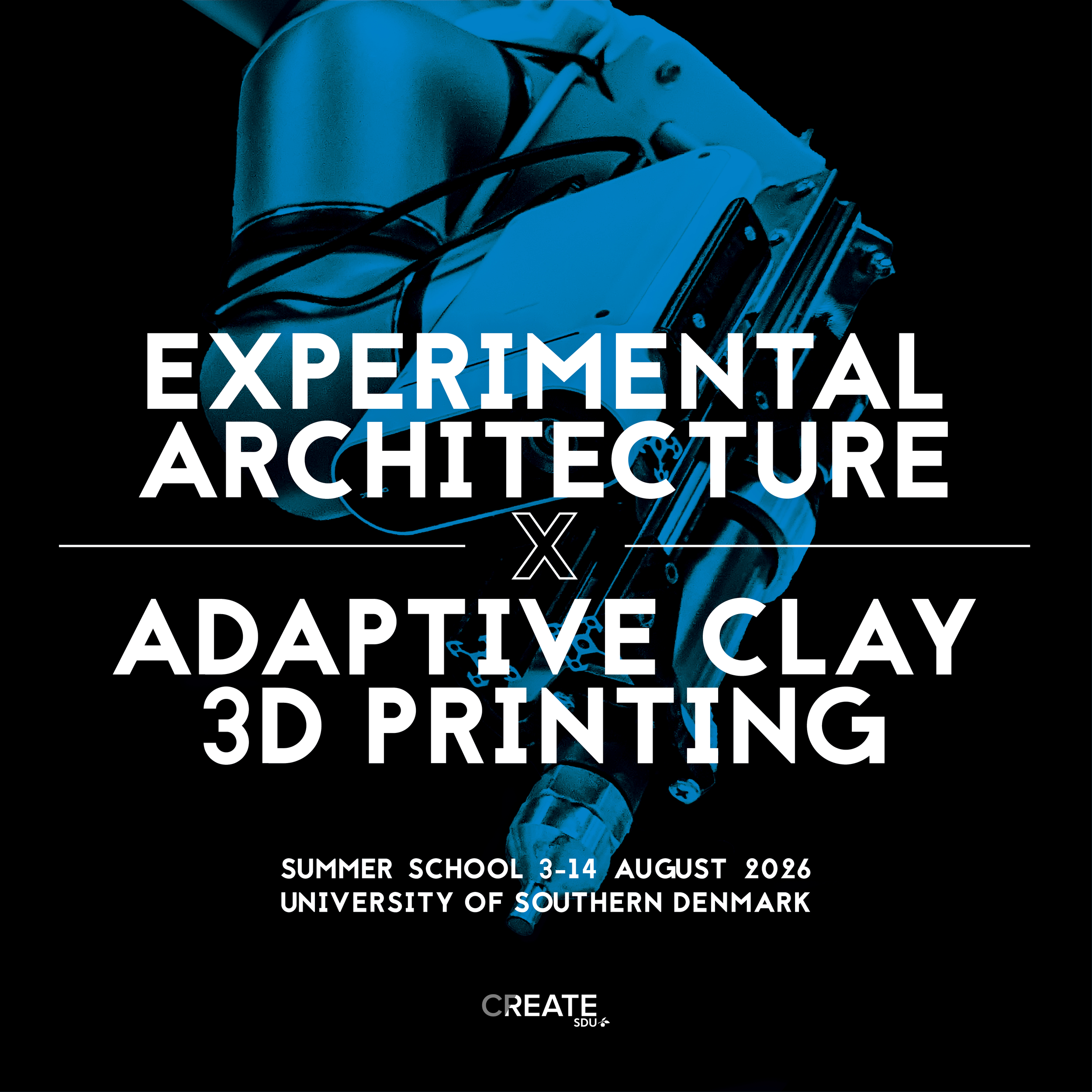
SUMMER SCHOOL 2026 UNIVERSITY OF SOUTHERN DENMARK © CREATE
SDU CREATE SUMMER SCHOOL 2026
SCHOOL FOCUS
In recent years, additive manufacturing has significantly influenced design and construction practices, enabling new approaches to material use, form generation, and fabrication processes. While clay 3D printing has been explored primarily through continuous extrusion methods, these approaches often remain constrained by predefined toolpaths and static strategies, limiting their capacity to respond to architectural intent, environmental conditions, and material behavior during fabrication.
This Summer School focuses on adaptive clay 3D printing as an approach to integrate real-time feedback into robotic fabrication workflows. With an emphasis on architectural applications, the program explores how discrete deposition methods and feedback-driven control can inform the formation of structures during printing. By investigating the relationship between sensing, computational strategies, and material response, participants will engage with fabrication as an active and evolving design process.
Through hands-on experimentation and collaborative work, participants will engage in the design and fabrication of prototypes using robotic systems, sensing technologies, and computational tools. Students will develop practical skills in discrete clay deposition, feedback-driven fabrication, and the integration of architectural thinking within adaptive production workflows.
adaptive clay 3d printing
HARDWARE - ROBOTIC clay 3d PRINTING
The Summer School utilizes an industrial robotic arm equipped with a clay extrusion end-effector for controlled material deposition. The setup supports both continuous extrusion and discrete deposition methods, allowing for the exploration of different fabrication strategies.
The system is complemented by a vision-based sensing setup used to capture the state of the print and its surrounding environment during fabrication. This enables monitoring of material behavior and supports real-time adjustments to the printing process.
SOFTWARE - 3D MODELLING AND SIMULATION
Basic knowledge of 3D modelling is recommended. The main software utilized is Rhinoceros 3D with Grasshopper, where participants will develop geometries and generate robotic toolpaths.
Robotic processes are coordinated through the Robot Operating System, which supports communication, control, and data exchange between sensing systems and robotic hardware. This system operates in the background and will be introduced conceptually, while participants interact with it indirectly through the modelling environment.
LEARNING OUTCOMES
THIS COURSE AIMS TO PROVIDE KNOWLEDGE ABOUT:
+ Advanced robotic fabrication technologies, their characteristics, possibilities, and limitations within the context of material-based additive manufacturing
+ Robot programming and control methods for multi-axis robotic systems applied to clay 3D printing and material deposition processes
+ The integration of sensing technologies and feedback systems in robotic fabrication workflows
+ Computational design tools and parametric modelling approaches that enable the connection between geometry, material behaviour, and fabrication constraints
PARTICIPANTS WILL BE ABLE TO WORK WITH THE FOLLOWING SKILLS:
+ Develop and implement robotic toolpaths for clay 3D printing, including adaptive and discrete deposition strategies
+ Operate and calibrate robotic fabrication systems for controlled material deposition
+ Integrate vision-based sensing systems to capture and process real-time data during the printing process
+ Fabricate, monitor, and iteratively adjust prototypes using feedback-driven robotic workflows
THROUGH THIS COURSE, participants will GAIN THE COMPETENCIES TO:
+ Plan and conduct design and fabrication experiments using robotic systems and feedback-driven workflows
+ Develop research-oriented projects in the field of robotic fabrication and manage the interaction between material behavior, sensing, and computational control
+ Prototype, test, and critically evaluate adaptive fabrication strategies in relation to design intent and material performance
+ Engage with iterative and feedback-based design processes through hands-on experimentation with robotic fabrication systems
Subscription and Fees
The course is open to professionals and students at Bachelor, Master, and PhD level from Architecture, Design, Engineering, and related fields. This is a two-week full-time intensive experience held in person (not online), that allows the students to be immersed in the research environment, develop and apply their skills in computational design and digital fabrication and push their knowledge to a new level.
The course is 5 ECTS credits for MSc and BSc students, and 7,5 ECTS for PhD students. Places are assigned on a first-come, first-served basis to a maximum of 20 students.
APPLICATION DEADLINE: 1st MAY 2026 through the Online Application System.
FEES VARY ACCORDING TO YOUR SCHOOL OF ORIGIN:
+ Exchange Students from Danish institutions and from SDU International Partner Universities - No Fees
+ EU Participants (non-partner institutions) ~ 640 €
+ Non-EU Participants (non-partner institutions) ~ 1250 €
Participants in the Summer School are offered accommodation at a student-friendly rate. You can find more information on the fee and accommodation here.
INFORMATION AND CONTACTS
For information about the general organization of the SDU International Summer School 2026, visit this page.
For questions related to the program, qualifications, or research topic (for PhD Students) please contact Assoc. Prof. Dr. Roberto Naboni and via email: ron@iti.sdu.dk.
For questions about subscription and administrative matters, please contact summerschool@sdu.dk.